

If you have been advised to undergo a transperineal prostate biopsy by one of the London Urology Collective specialists, it is completely natural to have questions about the procedure, what it involves, and the potential risks. The following information is designed to guide you through the process and help you feel well prepared.
What Is a Transperineal Prostate Biopsy?
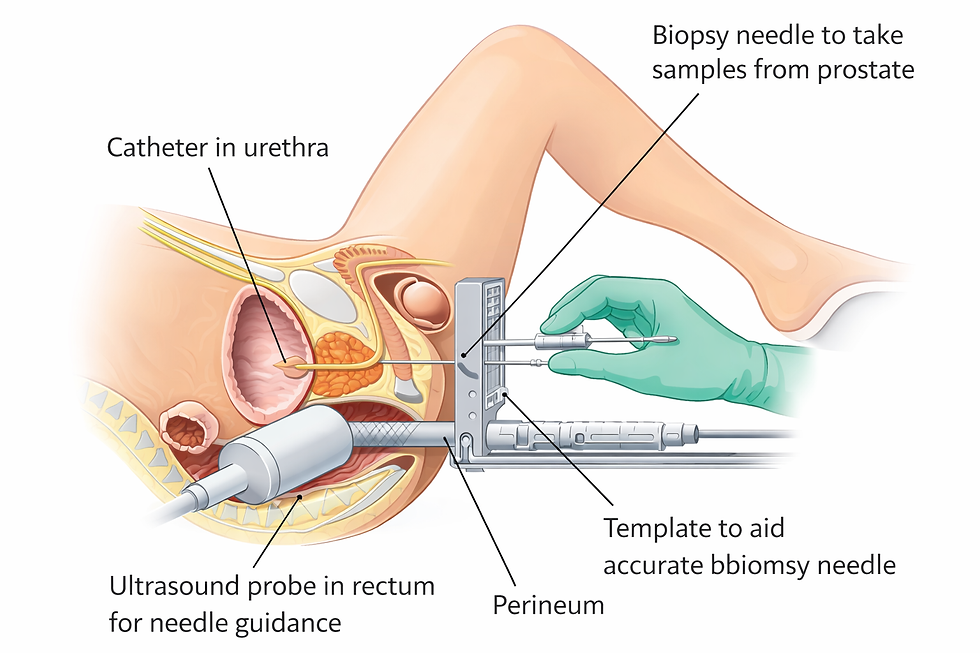
A transperineal prostate biopsy is performed to check for prostate cancer. An ultrasound probe is gently inserted into the rectum to visualise the prostate, and small tissue samples are taken through the skin of the perineum (the area between the scrotum and rectum).
The procedure may be carried out under local anaesthetic, spinal anaesthetic, or general anaesthetic. During your consultation, you and your specialist will discuss and decide on the most suitable approach.
What Are the Alternatives?
What Happens on the Day of the Procedure?
On the day, a member of the London Urology Collective team will review your medical history and medications, and the procedure will be explained again to ensure you feel fully informed and able to consent.
If a general anaesthetic is planned, the anaesthetist will talk you through the process and outline how your comfort and recovery will be managed.
If general or regional anaesthesia is used, you may be given compression stockings to reduce the risk of blood clots. Your medical team will advise whether these should continue at home.
During the Procedure
-
Preparation: You may receive an antibiotic tablet or injection before the biopsy to help prevent infection, depending on your clinical history and local protocols.
-
Positioning: You will be positioned so that the specialist can access the perineum comfortably. The area will be cleaned with antiseptic solution.
-
Local Anaesthetic: A local anaesthetic is applied, which may sting briefly.
-
Ultrasound Guidance: A slim ultrasound probe, roughly the width of a thumb, is placed in the rectum to provide clear imaging of the prostate.
-
Biopsy Sampling: Multiple samples are taken systematically from the prostate, with MRI images used to help target specific areas if needed.
-
Duration: The procedure typically takes 30–45 minutes. Most patients are able to go home later the same day.
Are There Any After-Effects?
You may experience some of the following temporary effects:
-
Blood in the urine: Very common and may continue for up to 10 days.
-
Blood in the semen: Extremely common and may persist for up to six weeks; it is harmless.
-
Bruising: Some bruising in the perineal region is typical.
-
Discomfort or temporary erectile difficulties: Usually due to bruising and generally short-lived.
-
Urinary retention or clot retention: A small proportion of patients may experience difficulty passing urine.
-
Infection or, rarely, sepsis: Infection can occur and may require antibiotics. In very rare cases, sepsis develops and needs urgent medical care.
What to Expect When You Get Home
-
Preparation: You may receive an antibiotic tablet or injection before the biopsy to help prevent infection, depending on your clinical history and local protocols.
-
Positioning: You will be positioned so that the specialist can access the perineum comfortably. The area will be cleaned with antiseptic solution.
-
Local Anaesthetic: A local anaesthetic is applied, which may sting briefly.
-
Ultrasound Guidance: A slim ultrasound probe, roughly the width of a thumb, is placed in the rectum to provide clear imaging of the prostate.
-
Biopsy Sampling: Multiple samples are taken systematically from the prostate, with MRI images used to help target specific areas if needed.
-
Duration: The procedure typically takes 30–45 minutes. Most patients are able to go home later the same day.

Why Choose London Urology Collective
We combine leading clinical experience with up-to-date knowledge of both established and innovative therapies. All treatment options are discussed clearly, allowing you to make an informed choice that best fits your needs and long-term health.
Consultant led care throughout
Subspecialist expertise
Rapid access to care
Clear and transparent fees
Convenient London locations

When to Seek Specialist Advice
You may benefit from a consultation if you experience:
-
Persistent blood in urine (visible or microscopic)
-
Ongoing urinary symptoms (burning, urgency, frequency) without clear cause
-
Recurrent urinary tract infections (UTIs)
-
Difficulty urinating (weak stream, hesitancy, incomplete emptying)
-
Suspected bladder, urethral, or prostate abnormalities
-
Unexplained pelvic or lower abdominal pain
-
Abnormal findings on urine tests, ultrasound, or imaging
-
History of bladder conditions or prior urological procedures requiring follow-up
-
Urinary retention or inability to pass urine — urgent
Early assessment can provide reassurance and allow timely treatment where needed.
Why Choose London Urology Collective
We combine leading clinical experience with up-to-date knowledge of both established and innovative therapies. All treatment options are discussed clearly, allowing you to make an informed choice that best fits your needs and long-term health.